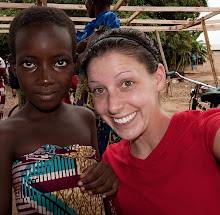
A final post about our last rescue trip in Ghana; if you need to catch up, start here.
As soon as we stepped onto the sand, I started looking for them. Had I known the faces of the other 20, I would've been looking for them as well, but all I knew for sure was to find the 2. The 2 boys from October, the ones I had met and shadowed as they worked. (You can read about that here and here.) The 2 who had shot cautious glances my way, not sure what to make of me, fearful of this stranger.

We sat under the mango tree and waited as the village gathered. One by one, children came out of huts along with teens and babies and adults, elders and fishermen and women of the village – everyone gathered. Hailey spotted him first – there's Dotse – but I hardly recognized him. With a fresh haircut and a striped shirt far improved over the stained, ratty Puma hoodie from before, he looked like any ordinary 11-year-old ready to take on the world. He hung back, acting shy, staying behind the crowd with a few other kids. But watching, always watching, and I wondered what he was thinking.
Michael appeared too, and I knew him immediately; though I hadn't seen them interact with each other in October, I could tell now that they were friends. They sat together on the front row of benches with the other 20, watching us and taking everything in. At 11 and 12, they were among the oldest, among the leaders in the group. When it was time to leave and get in the boat, they were the first of the group to climb aboard, talking excitedly.
I continued to watch the boys on the journey south. Their shyness slowly seeped out, replaced by smiles of confidence. Every now and then, I would catch one of them stealing a quiet moment away.
Once at the shelter, there was so much excitement: a nice meal, new beds, new school uniforms, new friends, new school books. They could not stop smiling/giving me the "why are you taking another picture of me" look. 

Before leaving, we had a chance to sit down with the boys and interview them, asking about life in Sabonjeda, what they liked about Challenging Heights, what they were most excited about, and what they wanted to be when they grew up.
Dotse, especially, was very open in our interview time with him, answering some pretty tough questions in front of us, whom he'd only been around a handful of times. The last question we asked was "what do you think about all the children who are still working on the lake"? JP translated his answer as this: He actually doesn't feel like going back there again so he doesn't even want to talk about how he feels about that. Touche.
******
I don't know that I give enough credit to a God who creates such resiliency in children. In a world where youth so quickly become jaded and scarred by their pasts – whether chosen or inflicted – I feel as if God has protected these little ones and covered them in a very special way. Though they have quite a long journey ahead – one that will not be easy and will not be handed to them – and they will always have memories of the past, they are quick to love, quick to forgive, quick to begin again. In just three days time, they are becoming kids again. Michael dreams of being a famous soccer player when he grows up, but if he cannot, he'd like to become a teacher. Dotse also would like to become a teacher.
The separation of past and the welcoming of dreams wasn't even possible when I met the boys in October. One of the greatest gifts of this work is getting to see the transformation that is taking place in their lives. We acknowledge that it is a slow transformation of healing – physically, emotionally, relationally. But a price cannot be placed on the ability to begin dreaming.
Michael and Dotse now have a future. They now are the future.

And so it began... I like to think that sometimes the Lord wants to just keep us on our toes, remind us who is really in control. In fact, I'm pretty confident of that! A few days before Saturday, we got word that additional paperwork was needed to complete the rescue and be able to transport the kids to the shelter. Long story short, we were able to get what we needed, but there was a bit of anxiety surrounding whether or not we would be able to stay on the projected timeline. That's the beauty of Ghana – with a limited window of time in country because of significant travel, we're to a large degree at the mercy of a culture which doesn't exactly place time as a high priority. But we were ready, the village was ready, and the Lord showed His favor once again.
After that, the rest of the journey went incredibly smooth. Much of that was a testament to the fact that Sabonjeda really has adopted the partnership that we initially presented – and not just that they're willing to work with us, but that they've taken on ownership of the project as a community. They've shown in tangible ways that they choose to live a better life – to give their own children and their trafficked children a better life as well.
This was evident in the ways they blessed the children and joined our team in praying over them as we met under the mango tree. This was evident in the ways they had many of the children dressed in clean clothes and with fresh haircuts. It was evident in the ways they walked with the children down to the boat, making sure they were safely settled in and ready for the journey. Perhaps not every village will respond in this manner, but so far we're 2-for-2, and that may just be a lesson of trust for us – that if we continue in seeking the highest good of each village, our established relationships will make all the difference in the ways we are received and sent off.


Watching our team walk out of the village with the children is always so surreal, and it happens so very quickly. I left the mango tree meeting in time to get down to the boat to shoot the group walking out. One of the fish cages was out of the water, so I climbed up to stand on it for a better view. And in about 3 minutes, the group was down to the shore area and all the kids were clamoring to get on the boat – and I was still standing 5-6' in the air realizing I should be on the boat too! I wish I could freeze that moment and look at it from every angle, see every child's face, every master's expression. It truly was a release, a celebration.

Once we climbed in the boat, the village waved and cheered and sent us off in great spirits. I can't imagine what the day was like for them. Happy to know the children will be able to go to school? Fearful of the future and the reality of no longer having the children to help them work? Wary of whether we really will be back, despite our promise to return the next week? Sad to see the children go, many of whom have been with them since infancy? I'm sure a mixture of all of the above. But I am so incredibly grateful that they are choosing new life and trusting the process. What a gift. We call this part of the process "rescue", but it's not just for the children; it's a true rescue for the entire village as well.
My favorite moment of the day, and perhaps of the entire trip, came right as we all settled in the boat and pushed off a little from the shore of the village. We had a comprehensive list of children – their names and ages – leading up to the trip, but those are never 100% confirmed until we're actually in the boat pulling away. We all counted the kids multiple times (making sure not a one was missing – and that we didn't have any stowaways!), and then Samuel called them all by name, one at a time. And that moment for me was so very rich. Hearing their names, matching those names with faces, placing identity on each.
Dear child, you are no longer a number on the lake; you are Kingsley and Dorcas and Hannah and Ame and Albert and Dotse and Roland and on and on. All 22 of you.
Yes, so much more than a rescue.
A few things are staple occurrences for me post-Ghana: One involves buying out the produce section at HEB and eating everything in sight. God help me when that eating happens to also include Grub burgers and fries followed by vats of Blue Bell (cheers to my juice-cleansing friends). The other involves a bombardment of cold air. Now I know it's wintertime and all, but what is this icy/snow business that has everyone running for cover? And for the love, can we turn off the air conditioners in the airports and restaurants and office buildings? Can't. Get. Warm. Yet truly, the physical adjustments aren't a big deal anymore. Two days of waking up at 4am and wanting to crash by 8pm, a few extra layers and bowls of ice cream, and I'm good to go. It's expected now, and life goes on. Except there's also this:
Much of our work involves "high points": annual fundraisers, world records, sold out races, moments in Ghana of walking out of villages with formerly trafficked children, watching them go to school and reunite with their parents, reading letters from those children a year later, the partnership of a new village, taking cage-raised fish to market, etc. I dare say few people get to experience things of this nature in everyday life like we do. God has been so faithful, and we want to shout it from the rooftops – so we do! These are the moments we proclaim and share; nothing brings more joy than telling the ways that God is bringing the Kingdom through Mercy Project; it's why we do what we do. The Lord has shown up and invited us to participate in His work time and time again. There's no greater gift.
But I, especially, tend to forget that the high points do not come without moments from the opposite end of the spectrum; I rarely confess that portion of the journey in as much detail. I've been dwelling on grace since the beginning of this new year, desiring to practice more grace for others in my life, wanting to better understand the ways the Lord is gracious to us all. Yet sometimes I forget that I need to allow myself some grace as well, that I need to name the times when I am far from the perfection I seek, when I can't do all and be all and need to just say that THAT'S OK. It's ok to admit that this work is hard, that the path isn't easy, that sometimes relationships are hard and change is hard, that there are days when it feels like I'm getting nowhere fast.
Yikes.
Perhaps that's a terrible thing to admit immediately following a rescue trip – the pinnacle of high points – but let's be real: the pressure to succeed and measure up is often greatest in the wake of jubilation, and I've felt the weight of it this week. To be clear, this is a pressure that I place on myself, fearing failure and incompetence. I don't want to admit it, because it makes me feel weak. I've needed to ask for a lot of grace this week, and I'm so grateful for those who have walked through that with me. The problem with pouring your heart into something so fully is that only the Lord can fill it back up.
What I'm learning is that it's okay to ask for help and ask for grace, even if it’s embarrassing, even if you disappoint people, even if in the process people find out (gasp!) that you’re not a super-person, but just a regular person, a person who gets. . . emptied out sometimes. -Shauna Niequist
And so.
I'm learning, and He is filling.
I continue to believe that in many ways my own story of rescue and redemption is tied up in the lives of these children in Ghana. That I don't "save the day" for them more than they save me – through their dreams and hopes to be teachers and doctors and futbol players, through their carefree dancing and singing and sheer joy, through their wild abandon for living life to the fullest each day regardless of what they've been through. Over and over and over, they save me.
So I have to start these stories with that honesty, that reality. Because if we don't let our stories change us, they are for naught.
And those high points from last week? Friends, there were so, so many. Without further ado, meet the FORMER trafficked children of Sabonjeda. Aren't they beautiful? Oh, how God is breathing new life and redemption into us all.

(click photo to enlarge; and if you're better at math than I, you'll notice there's only 21 in this photo. our friend Clifford had a rough morning as all little boys do from time to time and joined in for a later shot. keeping it real. :)
How do you recount those moments that really dig into the core of your heart? Not the kind where you think "that was really meaningful", or "I'll always remember this", but the kind that you know is changing the very nature of who you are in that moment. I continue to experience these moments in Ghana. Surprisingly, it's not the "highlight" moments that stick with me. Don't get me wrong; it's incredible to experience formerly trafficked children climbing into our boat and watching the same kids enter a bunk room at the shelter to pick out a new bed for the first time. Those are all special too, but for me, it's the look on the 15-year-old girl's face when she is told through translation that her mom loves her and wants her back, it's turning around to see a group of Americans and Ghanaians who don't have much in common culturally quietly praying under a mango tree together, it's watching your friends endure and pour out over and over again so that others may have abundant life. These are the stories I want to tell. They are the ones that bring light into the dark places and proclaim that in the midst of shadow, hope is present.
This past week renewed my hope. I often get bogged down by all the brokenness around me. We're surrounded by hurting people and devastating situations that are unfair and crippling in a world that proclaims "self" and confuses God's goodness with the desire for comfort and perfection. I've been burdened by that lately. But these kids and these moments – they are filling my heart up with a lasting hope. Hope that God isn't done yet and He is always bringing redemption and rescue in ways big and small; we need only to look for it. I'm anxious to share a few stories from our trip in the coming days. I want to be the kind of person who tells more tales of hope than of hopelessness, who focuses on the light instead of the great darkness, who continues to believe that we can all change the world one smile, one word, one moment at a time.

It is day 2 on the lake, and we attempt to arrive at Sabonjeda early. Somewhat accomplishing that, Hailey and I are able to go out on the lake almost immediately to meet some of the "list children" working. A fisherman and JP take us out in one of the wooden canoes sitting on the shore, barely above water once we all sit down, and I'm not sure how we're going to manage to keep 4 adults afloat for any length of time, much less be able to move without fear of tipping. At least the water is calm along the shoreline. I imagine the children who spend 8-10 hours a day in this boat, hauling in heavy nets, trying to balance, fearing the water.
At least I know how to swim.

We paddle out in a shallow area, much closer to shore than I anticipated. It's eerily quiet, and as we round a bend, there is Michael, the boy we have been looking for. The light is catching his net just perfectly, but all I notice are his eyes. Hollow, empty, almost angry. His body is rigid. Is he scared? Has he been told what is happening, or have these white people just appeared out of nowhere like paparazzi? It's horrible. While I still believe in the need to tell the story, in some ways this is harder. Thankfully, I know. I know the hope on the other side, that one day very soon this boy will have a different story to tell. We circle all the way around the boat, and Michael gives us a parting look.

My friend Dotse from yesterday has been brought down to the lake as we return. We swap boats for our large one and follow Dotse and his master further out for additional footage. Their boat reads "God Bless" on one side and "Pray for Life" on the other. How appropriate.

As we finish up and head back to shore, I notice that a group of kids have come out to pull in a net that is close to shore. We've seen these nets before – a few trips ago, 8-10 grown men labored to pull one in. This time, it is 12 children and 2 men. It takes them a solid 45 minutes, with no break, to wrestle the 100+ yard net, gathering it into a canoe as they go. The youngest children are untangling netting in the boat while the eldest heave on the net sides over and over again. Perhaps the children gathered once our filming presence was known, perhaps they are the kids of fishermen and not all trafficked children, perhaps they are putting on a bit of a show for the Obrunis. But it doesn't matter. It doesn't matter because children should not be working like this. 8-year-olds should not be throwing their entire body weight into a fish net, muscles bulging. And the little boy in yellow, sitting in the boat? He can't be more than 5.

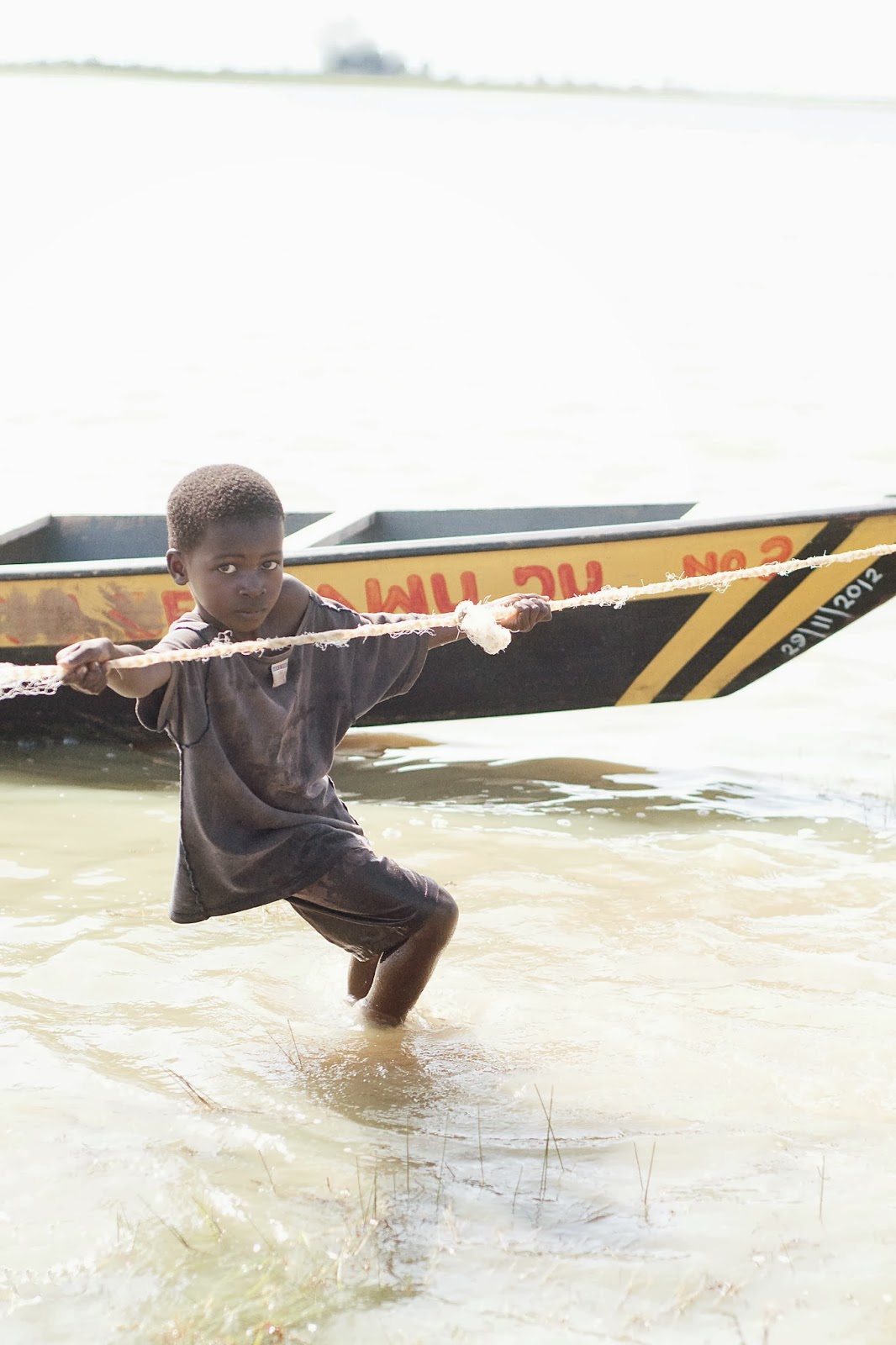


I have seen enough in these 45 minutes to last a lifetime.
The rest of the day is spent under the mango tree, where our social workers question and interview masters and village leaders. They are fantastic at what they do, and I am reminded how incredible it is to watch Jesus followers leaning into their gifts for the Kingdom. Later, we prepare to leave, and the village children follow us down to our boat. Sam asks for the "list kids" to gather for a photo. They don't really understand what it means to be on "the list" yet, but Lord-willing they will soon. Soon. I'm hurrying, trying to get a headshot of each child, hearing their names for the first time, and then Sam is saying "here is Michael". I turn and do not recognize the boy from this morning standing in front of me. For this time, he is grinning shyly, the emptiness in his eyes replaced with a glimmer of hope. Soon, Michael, soon.

*********
It came down to this for me:
If I look at the mass I will never act. If I look at the one, I will. – Mother Teresa
For this trip, this trip was about the one. The individual faces looking up at me – Dotse and Michael and others. 7,000 is an incredibly overwhelming number, and the vastness of Lake Volta is indescribable. But instead of remaining paralyzed, I am learning to focus on the one. One village, one master, one child.
It's time to act.
Ghana trip continued...
Justice means moving beyond the dichotomy between those who need and those who supply and confronting the frightening and beautiful reality that we desperately need one another. – Rachel Held Evans

Our approach towards working with the fishermen in Ghana has always been holistic; we don't sweep in, gift them with our great Western knowledge, and try to put a band aid on the challenges they face. We've chosen a route and process that is long and arduous, that is challenging and ofttimes frustrating. But it creates a unity and partnership within the villages and within our interactions that is deeply rooted, that is equal. It is the simple acknowledgement that we need each other. The village needs our support and a "manual" on cage fishing; we need their partnership and a decision to change generations of economic hardship. It's a balancing act. Not without mistakes on both sides, but with just enough understanding and grace for each other.
***
We spend two days out on the lake and in the fishing villages. Most of the time is spent at Sabonjeda, our second partner village; the final afternoon we check in with Adovepke, our first. My main purpose this trip is to capture footage of the Sabonjeda "list kids" so that we have some documentation before the next rescue. I have an agenda, a very clear idea of the shots I want, angles and backgrounds, how it all fits together in my head. And within 5 minutes of stepping in the village, I recall the stupidity of that planning, for there's something about Ghana that renders agenda useless. It's the simple nature of a culture where time is irrelevant. It's frightening to my list-making self to be bound by nothing save epically long mango tree meetings and waiting hours on so-and-so to tell so-and-so to go get so-and-so. But this is the part of the journey in which we need them. We (I) need to be taught to slow down, to forget time for awhile, to share a meal with each other, to be patient, to learn to see others as same. We are greeted warmly by Merci, the only female committee member in the village; she speaks minimal English and has been waiting to receive us. So we settle in and spend the day just "being". And low and behold, it is beautiful.

The boy's name is Dotse (do-che), and he's wearing a long red Puma shirt with a hood. It reminds me of my nephew, who loves Puma and is about the same age and size. Dotse is beckoned over to our circle, asked to join in, and hesitates at the offering of a plastic chair reserved for the nicest of guests. His ducked head and wary eyes speak volumes. Questions are asked and answers debated, and then suddenly we go, dismissed for him to show me how he spends his time during the day. I follow his bare footprints down a dirt path, his master leading the way to a small open-air hut where fish nets are spread out in every direction; Dotse immediately starts to work. I change lenses and do the same. It strikes me that he is so very good at what he's doing. His hands work quickly, methodically, and without mistake as he gathers and weaves the netting. I wonder, is he proud to show me what he can do? Does he have any idea what on earth is happening? Is he embarrassed that all the attention is on him? Scared and anxious as if on display? After a time, he rises and goes to another net, adding weights down one end using his small fingers and teeth. He moves to a third net, never so much as glancing up, working hard to impress, his fingers flying over the netting. The fact that this child's motor skills are ridiculously advanced is not lost on me. It's rather frightening.


Later, lucky for Clint and Hailey (!), one of the women offers us banku and tilapia sauce before we depart. This is such a culturally generous offer that we cannot help but accept. The village is a total maze of huts and paths, and it seems we walk all around it, only to end up right back where we started. And then I realize we're in the same open-air hut in which Dotse was working earlier in the day. It is his "family unit" that is offering to feed us. To be vulnerable, to share life, to give to strangers in order to become friends, to trust. This is the justice that transcends.
Gathered around a small wooden table, I look up and am rewarded with a slight grin from Dotse, who is standing off to the side with a few other kids, just watching. He doesn't know it, but this little boy has changed me. A beautiful justice.