It is day 2 on the lake, and we attempt to arrive at Sabonjeda early. Somewhat accomplishing that, Hailey and I are able to go out on the lake almost immediately to meet some of the "list children" working. A fisherman and JP take us out in one of the wooden canoes sitting on the shore, barely above water once we all sit down, and I'm not sure how we're going to manage to keep 4 adults afloat for any length of time, much less be able to move without fear of tipping. At least the water is calm along the shoreline. I imagine the children who spend 8-10 hours a day in this boat, hauling in heavy nets, trying to balance, fearing the water.
At least I know how to swim.

We paddle out in a shallow area, much closer to shore than I anticipated. It's eerily quiet, and as we round a bend, there is Michael, the boy we have been looking for. The light is catching his net just perfectly, but all I notice are his eyes. Hollow, empty, almost angry. His body is rigid. Is he scared? Has he been told what is happening, or have these white people just appeared out of nowhere like paparazzi? It's horrible. While I still believe in the need to tell the story, in some ways this is harder. Thankfully, I know. I know the hope on the other side, that one day very soon this boy will have a different story to tell. We circle all the way around the boat, and Michael gives us a parting look.

My friend Dotse from yesterday has been brought down to the lake as we return. We swap boats for our large one and follow Dotse and his master further out for additional footage. Their boat reads "God Bless" on one side and "Pray for Life" on the other. How appropriate.

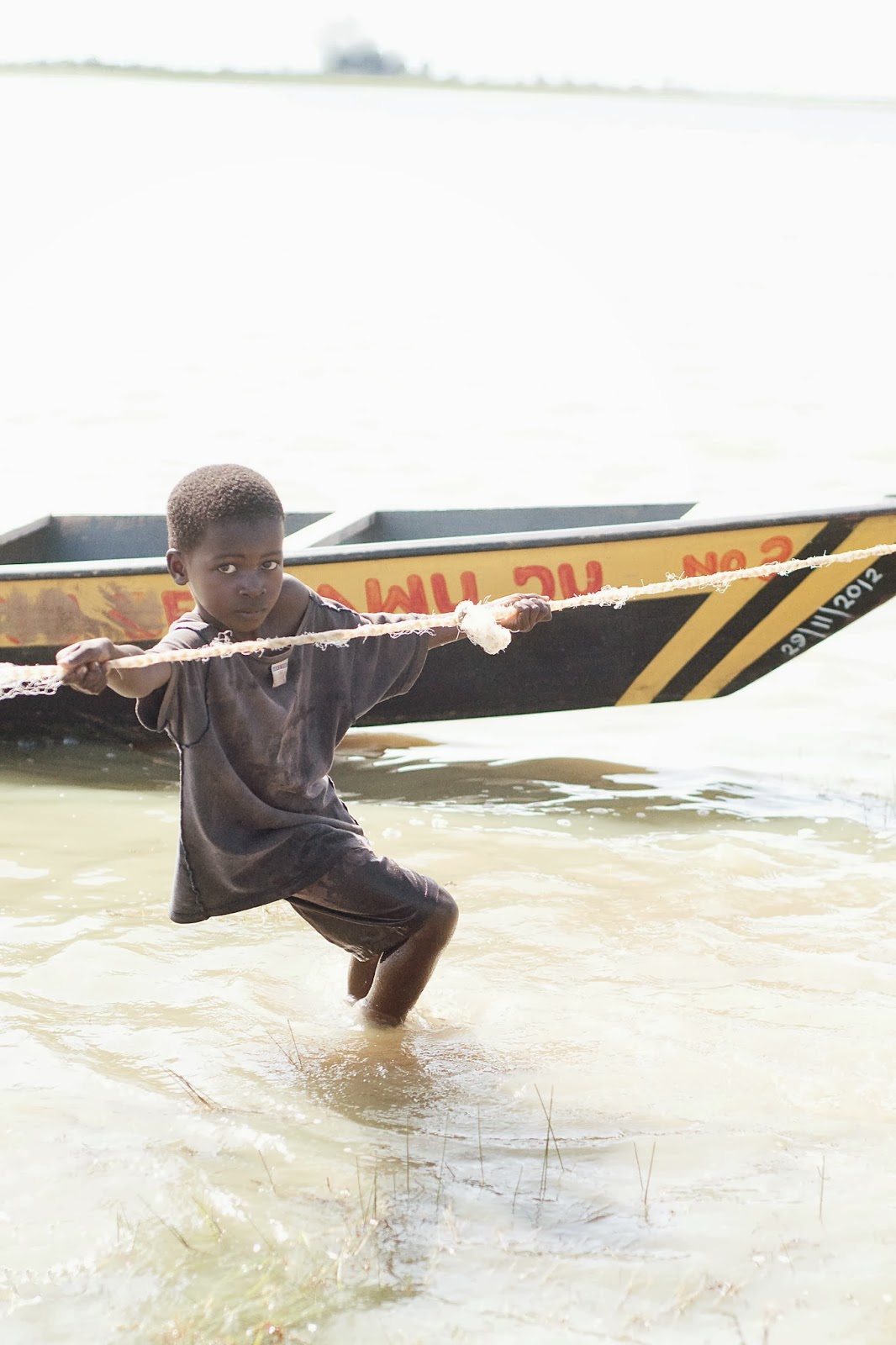
As we finish up and head back to shore, I notice that a group of kids have come out to pull in a net that is close to shore. We've seen these nets before – a few trips ago, 8-10 grown men labored to pull one in. This time, it is 12 children and 2 men. It takes them a solid 45 minutes, with no break, to wrestle the 100+ yard net, gathering it into a canoe as they go. The youngest children are untangling netting in the boat while the eldest heave on the net sides over and over again. Perhaps the children gathered once our filming presence was known, perhaps they are the kids of fishermen and not all trafficked children, perhaps they are putting on a bit of a show for the Obrunis. But it doesn't matter. It doesn't matter because children should not be working like this. 8-year-olds should not be throwing their entire body weight into a fish net, muscles bulging. And the little boy in yellow, sitting in the boat? He can't be more than 5.



I have seen enough in these 45 minutes to last a lifetime.
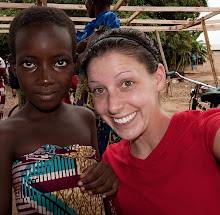
The rest of the day is spent under the mango tree, where our social workers question and interview masters and village leaders. They are fantastic at what they do, and I am reminded how incredible it is to watch Jesus followers leaning into their gifts for the Kingdom. Later, we prepare to leave, and the village children follow us down to our boat. Sam asks for the "list kids" to gather for a photo. They don't really understand what it means to be on "the list" yet, but Lord-willing they will soon. Soon. I'm hurrying, trying to get a headshot of each child, hearing their names for the first time, and then Sam is saying "here is Michael". I turn and do not recognize the boy from this morning standing in front of me. For this time, he is grinning shyly, the emptiness in his eyes replaced with a glimmer of hope. Soon, Michael, soon.

*********
It came down to this for me:
If I look at the mass I will never act. If I look at the one, I will. – Mother Teresa
For this trip, this trip was about the one. The individual faces looking up at me – Dotse and Michael and others. 7,000 is an incredibly overwhelming number, and the vastness of Lake Volta is indescribable. But instead of remaining paralyzed, I am learning to focus on the one. One village, one master, one child.
It's time to act.
Showing posts with label village. Show all posts

Alright, time to crank out the trip report. This one is rather long, but I just couldn't deal with splitting it up further. I solemnly swear the rest won't be so lengthy. Maybe.
I truly cannot say enough good things about our group this year; they not only made the trip easy for Jared and I, they made it so very enjoyable! We spent three full days up on the lake – speaking in our partner villages, meeting kids working on the lake, and visiting several of our reintegrated children.

Here's a little glimpse into the first two days:
Once again, I'm walking back into Adovepke. The boats lined up on the lakeside, the layout of the thatched huts, the greetings and smiles on faces I know – it's all familiar in the best of ways. It's good to be back. We sit in on a "short" church service so that the group can experience African worship at its finest. And coincidence-I-think-not, the lesson preached was from none other than the book of Micah. I'm not surprised when the people ask us to "bring them a song". Thankfully, they quickly join our croaks with solid accompaniment. Here, in a mud brick building, I find true worship.

We meet with the chief and several of the fishermen, impressing upon them once again that we are in this for the long haul, that we will continue to visit, check up, and partner with them on the fish cages. They recognize me as "the one with the photos". Here, under the mango tree, I find friends.

Fishing cages are worked on over the course of the day, and the group spends much of the time playing with the village children. There are coloring books, candy, pictures, and... jump rope! The first time we brought one, and it was a huge hit. One of my favorite moments. Here, among smiling faces and laughter, I find joy.
******
The next day, we walk into the village of Sabonjeda, my first visit. It strikes me as even more authentic African than Adovepke (if that's even possible). It seems simpler, more widespread and much larger. The people gather quickly but are at first hesitant to join us under the mango tree – the children especially. In a few short hours, that certainly changes, but the questions are present in body language and demeanor: what is your business here? Can you be trusted? Why so many of you? And yet, we are brought the finest chairs, while they take the wooden benches across from us, the village secretary and the chief seated to my right. A grand display – nothing but the best – even for unknown guests. Here, sitting in a plastic stacking chair, I find true hospitality.

Jared and I greet the crowd that has now gathered, introduce our group members, and explain our visit as one of merely checking in to see how they're getting along, to play with their children, to affirm that we are "with them" and excited for their partnership. They receive us well. I have the privilege of sharing that JP, our usual spokesman, is not with us because he has gone to get materials for their fish cages and will soon be arriving, ready to build out the project that we have promised. The watchful eyes grow large and clapping erupts. All hesitancy melts away in that instant. Here, in newly charted waters, I find partnership.

But then, then there are questions. Many questions. I am floundering in my head to come up with the best answers and praying as the words come out in response that they are right and good and exactly what needs to be heard. I've always been the observer, never the communicator, and I immediately have much more respect for this task! I've never been more grateful for the language barrier that at least allows me time to think and toss around answers before responding fully. Questions of timing and hypothetical 'what if's' in regards to owed payment for children (in the form of a cow) and to trafficking family members. My soul breaks a little; this moment of discussing buying and selling children is forever ingrained in my memory. Here, I find myself grateful for the ability to shelve emotion. Yet even in the midst of the conversation, I tell the fishermen that they ask good questions, because this affirms that they are on board, that they are equally in the partnership, that they desire to learn and understand, that they care. And in that realization, here, in the middle of the chaotic exchange of words, I find two worlds colliding for good.

As we leave the village a short time later, I feel more like a friend and less like a stranger. But this process is hard. It's not glamorous. It comes with mistakes and questions and tough moments. It's long and often daunting. And sometimes it's two steps forward and one back. But each step comes with equal part gift, short glimpses of light and a richness that cannot be described or bought. We hold fast to that.

Here, as always, I find hope.